Jan
07
RTD Bihar

Food Hygiene & Safety Training
EP Infoways Pvt. Ltd. is a registered Training Partner with FOSTAC – FSSAI for Training and Certification.
ISO 22000 is a broader food safety system that is fully based on quality principles. HACCP is a risk management tool that prevents food safety hazards from ever occurring in the first place. ISO 22000 incorporates HACCP principles and regulations.
A food safety management system (FSMS) is not only a legal requirement but a helpful tool to ensure safe practices are followed within your business. A FSMS is a systematic approach to controlling food safety hazards within a food business in order to ensure that food is safe to eat
FSSC 22000 scheme, in contrast to the ISO standard, is recognized by the GFSI (Global Food Safety Initiative). GFSI recognition demonstrates that the scheme meets the highest standards globally leading to international food industry acceptance.
From farm to factory to fork, food products may encounter any number of health hazards during their journey through the supply chain. Safe food handling practices and procedures are thus implemented at every stage of the food production life cycle in order to curb these risks and prevent harm to consumers.
Hence we are organizing this Awareness training session for these system implementations on food safety.
BOOKING LINK
Payment Link for Food Hygiene & Safety Training
Fee – Rs. 750/- 
 Food Safety Training & Certification (FoSTaC) Legal context – As per the portal – https://foodlicensing.fssai.gov.in/PDF/FoSTaC_uploading.pdf
ISO 22000 is a broader food safety system that is fully based on quality principles. HACCP is a risk management tool that prevents food safety hazards from ever occurring in the first place. ISO 22000 incorporates HACCP principles and regulations.
A food safety management system (FSMS) is not only a legal requirement but a helpful tool to ensure safe practices are followed within your business. An FSMS is a systematic approach to controlling food safety hazards within a food business to ensure that food is safe to eat
FSSC 22000 scheme, in contrast to the ISO standard, is recognized by the GFSI (Global Food Safety Initiative). GFSI recognition demonstrates that the scheme meets the highest standards globally leading to international food industry acceptance.
From farm to factory to fork, food products may encounter any number of health hazards during their journey through the supply chain. Safe food handling practices and procedures are thus implemented at every stage of the food production life cycle to curb these risks and prevent harm to consumers.
Hence we are organizing this Awareness training session for these system implementations on food safety.


 Advance training payment link –
Considering India’s target to achieve a GER of 35% by 2025, there was a need to allow more quality-driven institutes to harness the power of online learning. Changes in textbooks and syllabus cannot keep pace with the rate at which technology is evolving which makes online learning imperative and not just a catalyst in the fast-changing environment.
Union Finance Minister Nirmala Sitharaman announced in her Budget 2020 speech that the top 100 educational institutions in the National Institutional Ranking Framework (NIRF) will be offering full-fledged degree programmes online, the focus was on providing quality education across the spectrum, more specifically to the deprived sections of the society. UGC had floated the norms for online degrees and said universities that are accredited by the National Assessment and Accreditation Council with at least a score of 3.01 on a scale of 4, or those who have found a place in the top 100 list of the National Institutional Ranking Framework can apply for offering fully online programmes. Fully-online degrees are an extension of India’s larger plan to open up and liberalize higher education
What is Online degree
An online degree is an academic degree that can be earned primarily or entirely through the use of an Internet-connected computer, rather than attending college in a traditional campus setting. Improvements in technology, the increasing use of the Internet worldwide, and the need for people to have flexible school schedules while they are working have led to a proliferation of online colleges that award associate, bachelor’s, master’s, and doctoral degrees.
Advantage of an online programme is that it democratises education, which means more people will now find access to good institutions. For many students, online degree courses are cost-effective and so can be very helpful for those who do not have the financial capability to study in expensive colleges. Online Learning is an ideal option to gear every learner’s career goals from their comfort zones without putting the future on hold.
Online degrees are treated at par with regular degrees. With many high-quality institutions now offering online degrees, employers are more positive than in the past and are accepting online degrees.
New technologies are spreading tentacles in growing job market so working professionals are expected to remain updated with the latest skills. Also, the affordability of the internet over the last few years has given birth and popularity to the non-traditional method of acquiring education through online degree programs. The online degree programs are crafted to suit the requirements of working professionals who want to enhance skills through time and cost-effective programs.
Some of the benefits of Online Degree programs are:
1. Education can be carried together with work- life balance: There is no need for working professionals to quit job for higher education rather they would acquire a full-time degree in online mode maintaining their professional life and work- life balance. Now individuals need not have a gap on their resumes to acquire higher education and skill enhancement.
2.Gaining popularity amongst employers: If one pursue degree together with job, value of individual enhances amongst your team mates and employer. Also it has been observed that individual’s performance and productivity increases. As the value of online degree is same as offline degree so popularity and reliability of such programs have increased significantly.
3. Enhances real-world application of knowledge : Pursuing online degree together with job gives an edge as aspirants learn new things and best practices that can be applied immediately in their current jobs.
4. Enhances flexibility of Choice: Online degree provides better flexibility as one do not needs to work around the schedule decided by the educational institution. Online mode provides advantage in maintaining work life balance.
5. Enhances flexibility in choosing Location and course : Location is not a constraint as you can learn from any location and can pursue any of the course of your choice
8. Inculcates self-discipline: Online degree program inculcates self-discipline in individual as there is no one telling you what to do or not to do. One needs to be disciplined enough if he wants to progress.
Online vs regular education
Obtaining degree online is more convenient than obtaining it by regularly going to campus for the same. Especially for people with jobs, families, and other commitments that make it difficult to move or maintain a regular schedule.
| Basis of comparison | Online Education | Regular/Traditional Degree |
| Flexibility | Online degrees allow one to study as per your convenience. This is ideal and beneficial if you have working professional and also have to maintain work life balance. | Lesser flexibility is there in case of traditional campus method as you have to follow the regular fixed schedule. |
| Price | Online degree will be priced at lower or same price as the on-campus version when it comes to tuition fees, but being able to complete it from home has one big advantage: fewer living expenses. | Regular degree in comparison of online degree is far more expensive to obtain as residential expenses are added in case you go for residential degree and also cost for regular degree is at higher side. |
| Choice | The adaptability of online degrees works both ways. You have full liberty to choose any course from all round the world irrespective of distance.
If you wish to study something niche then an online degree can be a great way to do so. |
You have to see all constraints to select the course. There is limitation in |
| Social life | Studying by yourself at home for hours on end can isolate you from another aspect of the university experience and making friends | A group environment can be very motivating, helping you see things from a different perspective or get help when you’re stuck. |
| Independence | One of the biggest things young people in particular miss out on by studying online degrees is the opportunity to move away from home. This might sound unimportant, but actually it forms what is, for many people, one of the most valuable parts of the university experience | Students who study abroad, in particular, learn life skills like adaptability, resilience and initiative that are difficult (though not impossible) to get when you’re attending lectures from your own home. To use an oft-quoted cliché, it pushes you out of your ‘comfort zone’. |
| Resources | There are some things you simply can’t study at home. Maybe you need specialist equipment, tools or materials to really become an expert on your chosen subject. | Universities have a host of top-notch resources for you to use that you typically can’t find off campus. |
List of universities
UGC has approved 38 universities to offer full-fledged online degree courses in India. These universities, which include 15 deemed-to-be universities, 13 state universities, three central universities, and three private universities, do not need to get prior approval from University Grants Commission from the same.
The bottom Line
Online degrees are changing the face of education. They have “leveled the playing field’ for access to education. The way online degree programs are growing they have promising future as they provides access to education to a larger section of the population.
Degree program (UG)
BBA / BA / B.Com / BCA
3 Years
12th Pass
Pay After Placement
₹18,000.00 – ₹30,000.00 (vary as per university)
Online
As per the University criteria
Online
18 Years+
• UGC entitled University
• 132 credits (1 Credit = 30 Learning hours)
• Many certificates related to course
• 12th Pass Mark sheet
• Valid Identity Card issued by the government
• Any time learning
• Online exams
• Credit Transfer facility available
Bachelor’s degree can open a path to a many opportunities.

EP Infoways Pvt. Ltd. is registered Training Partner with FOSTAC – FSSAI for Training and Certification.
Food Safety Training & Certification (FoSTaC)
Legal context – As per the portal – https://foodlicensing.fssai.gov.in/PDF/FoSTaC_uploading.pdf
EP Infoways Details can be seen – http://epinfoways.com/fostac
We are doing training in Various Domain –
Date of Training –Advance Manufacturing 30th Sep
Date of Training –Advance Catering 30th Sep
Date of Training –Advance Storage and Transport 1st Oct
Time – 9 AM – 6 PM
Training Options – Advance Catering or Advance Manufacturing
Training City Available – 57 SECOND FLOOR sector 3 near sector 16 Metro Station Noida – 201301
Full day Training Program with Lunch and High Tea available.
Venue of training will be informed Later.
Fee – Rs. 2000 + GST = Rs. 2360
Why This Training is Important –
Mandatory Training and Certification of ‘Food Safety Supervisors’ for FBO
Kindly refer to our communication regarding FSSAI mandatory training and certification of food Safety supervisors
As you may be aware that In pursuance to section 16(3)(h) of Food Safety and Standards Act, 2006, the Food Safety Standards Authority of India(FSSAI) has to provide certification and training programs in food safety and standards for persons who are involved in food business whether as food business operators, employees or otherwise. Also list of mandatory courses as notified by FSSAI, as per category of licensed FBO is given in enclosures.
The food Authority, in its 24th meeting dated 21.09.2017 approved in principle the guidelines of Food Safety Training and Certification that envisage, inter-alia, that all food business having either central licence or state licence should have trained and certified Food Safety Supervisor, for every 25 food handlers or part thereof in each of their premises. These supervisors would carry periodic training to all food handlers in their premises and maintain records of food safety audit and inspections. Kindly see the attachments as enclosed for official order.
Accordingly all business operators are advised to nominate at least one food safety supervisor, for every 25 food handlers, in their each of their premises and get them trained under FSSAI-FoSTaC by 31st December 2018 through training partners empanelled by FSSAI.
In compliance to the above EP Infoways Pvt Ltd, which is the authorized licensed training partner under FSSAI request you to please send the nomination in the number as required by Act for the FOSTAC training Program, to the undersigned at the earliest.
For Any Query Mail – fostac@epinfoways.com
Mandatory Notifications from FSSAI –
http://epinfoways.com/wp-content/uploads/2020/03/2-FSSAI-Letter_FBOs_Training_08_02_2018-1.pdf
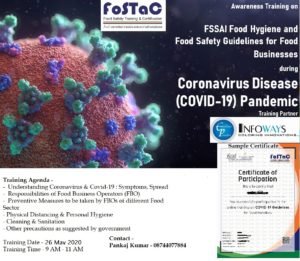
Sample Certificate –


Food Hygiene & Safety Training
EP Infoways Pvt. Ltd. is a registered Training Partner with FOSTAC – FSSAI for Training and Certification.
ISO 22000 is a broader food safety system that is fully based on quality principles. HACCP is a risk management tool that prevents food safety hazards from ever occurring in the first place. ISO 22000 incorporates HACCP principles and regulations.
A food safety management system (FSMS) is not only a legal requirement but a helpful tool to ensure safe practices are followed within your business. A FSMS is a systematic approach to controlling food safety hazards within a food business in order to ensure that food is safe to eat
FSSC 22000 scheme, in contrast to the ISO standard, is recognized by the GFSI (Global Food Safety Initiative). GFSI recognition demonstrates that the scheme meets the highest standards globally leading to international food industry acceptance.
From farm to factory to fork, food products may encounter any number of health hazards during their journey through the supply chain. Safe food handling practices and procedures are thus implemented at every stage of the food production life cycle in order to curb these risks and prevent harm to consumers.
Hence we are organizing this Awareness training session for these system implementations on food safety.
SOLO BOOKING LINKS
Payment Link for Food Hygiene & Safety Training
Fee – Rs. 1000/-
PAYMENT LINK FOR LAMINATED HARD COPY OF CERTIFICATE
Fee – Rs. 150/-